

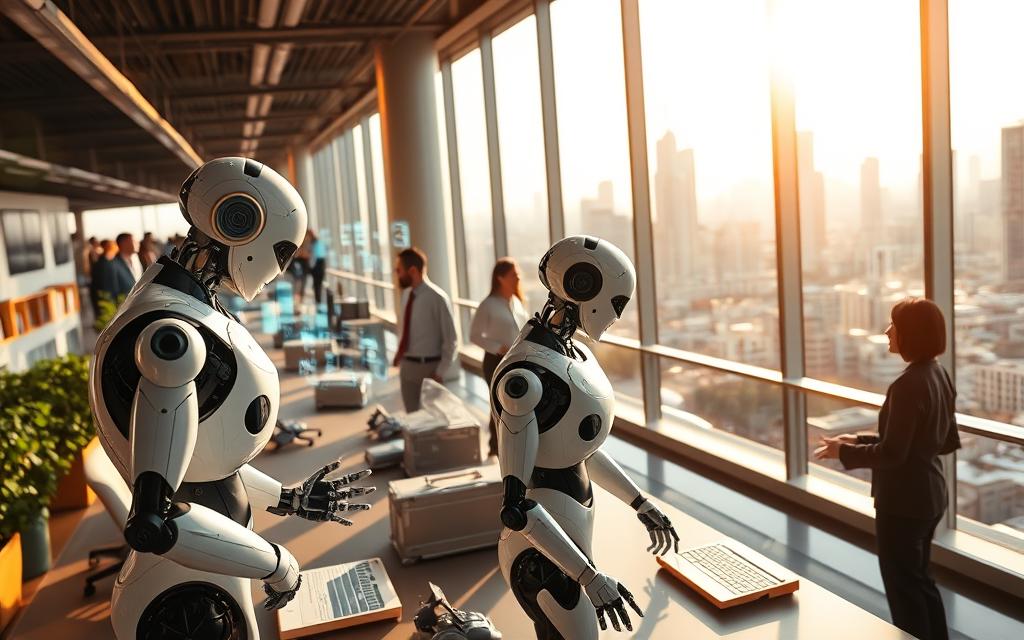
The debate about humans and artificial intelligence has moved from theory to reality. PwC and McKinsey projections show 60% of jobs will change a lot by 2030. Goldman Sachs believes 300 million jobs could disappear worldwide.
This big change is like an “economic balancing act” as Ray Dalio calls it. It means we need to adapt our careers fast.
AI is getting better at tasks, like analyzing documents with 90% accuracy. About 30% of US jobs could be automated in six years. But, the future isn’t about replacing humans with AI.
It’s about working together with AI. While AI can do 60% of admin tasks, jobs that need emotional smarts and creativity are for humans.
Now, workers need to learn skills that go well with AI. As 40% of coding tasks could be automated by 2040, we should focus on strategy and ethical AI use. The key is to learn to live with AI and use our unique strengths.
The Current State of AI in the Workforce
Artificial intelligence is changing work at an incredible pace. It’s transforming industries from the factory floor to the corporate boardroom. Over 67% of US businesses have started using RPA implementation by 2022, McKinsey reports. This is thanks to cognitive automation, which is now making complex decisions that were once human tasks.
Automation’s Rapid Adoption Across Sectors
Manufacturing is at the forefront of this change. Robotic assembly lines are now 99.8% accurate, beating human workers in the automotive and electronics sectors. Companies like Amazon are using machine learning adoption to predict shipping delays 12 hours early. This has cut delivery costs by 19%.
Language Processing Systems
Harvey AI’s contract analysis tools show the power of cognitive automation. They review legal documents with 90% accuracy, beating junior lawyers’ 76% rate. Bloomberg’s Terminal now answers complex financial questions in natural language, cutting research time by 40% for analysts.
Related Posts:





AI Capabilities Surpassing Human Performance Benchmarks
A 2024 IPPR study found AI systems do tasks 3.2 times faster than humans, with 82% fewer errors. This gap is even bigger in data-heavy fields. BlackRock’s Aladdin platform automates 73% of back-office work, freeing up staff for client interactions.
Predictive Analytics Tools
Walmart’s supply chain AI beats veteran planners, forecasting demand with 94% accuracy, compared to humans’ 78%. It looks at 57 variables at once, from weather to TikTok trends. This is something humans can’t do with machine learning adoption.
Pharmaceutical companies like Pfizer are using RPA implementation to speed up clinical trial data processing by 8 times. This change brings both challenges and new opportunities for the workforce.
What Will Humans Do When AI Takes Over Key Industries
AI is changing the game in many areas. It’s making big changes in how we work. Now, jobs in manufacturing and services are evolving fast.
Lights-out manufacturing and cognitive augmentation tools are becoming common. This means humans are adapting to new roles.

Manufacturing and Logistics Transformation
The car industry is using robots to help workers. Amazon’s warehouses have fewer people picking items than before. DHL’s AI has cut down on shipping mistakes by 40%.
Robotic Process Automation Case Studies
| Company | Implementation | Human Workforce Impact | Displacement Timeline |
|---|---|---|---|
| Tesla | Assembly line cobots | 30% faster production | 2022-2025 |
| Amazon | Warehouse robotics | 65% automation rate | 2018-2024 |
| DHL | Predictive routing AI | 20% staff redeployment | 2020-2023 |
Knowledge Work Revolution
Legal teams are using AI to review more contracts. A study from Stanford says this will grow by 2025. Diagnostic AI is helping 92% of NHS radiology departments.
AI-Assisted Legal Document Analysis
Top law firms are seeing big changes:
- Due diligence is 78% faster
- Clerical errors are down 60%
- Paralegal roles are changing by 40%
Medical Diagnosis Support Systems
The Lancet predicts 63% of medical admin will be automated by 2026. Nuance DAX Copilot handles 83% of clinical notes. This lets doctors:
- Spend 50% more time with patients
- Reduce diagnostic errors by 29%
- Focus on complex cases
These changes show a clear trend. Humans are focusing on quality and working with AI. AI is helping, not replacing, in many areas.
The Human Skills Defying Automation
While algorithms handle spreadsheets and robots tighten bolts, a big question pops up: What makes human workers indispensable in an AI-dominated world? Research from Northwestern University shows a key fact – 78% of top bosses focus on tacit knowledge retention when using automation. This hidden knowledge is what machines can’t copy.
Creative problem-solving capabilities
IDEO’s design thinking shows why humans are better than AI in tricky situations. Humans do things that machines can’t:
- They solve complex problems with adaptive thinking
- They mix different information sources
- They come up with unexpected solutions
OECD’s 2040 forecast says only 9% of jobs in strategic innovation will be at risk. This shows our brains are ahead of machines.
Emotional intelligence requirements
Client relationship management
KPMG’s advisory teams kept 92% of clients after introducing AI. They mixed data analysis with interpersonal communication. As one partner says:
“Clients trust people more than algorithms.”
Conflict resolution techniques
Mayo Clinic saw a 34% jump in patient happiness with human care. Gallup’s data also shows teams with good mediation skills do better:
| Metric | Human-led | AI-mediated |
|---|---|---|
| Conflict resolution success | 81% | 47% |
| Employee satisfaction | 89% | 62% |
This shows why 73% of Fortune 500 companies now focus on teaching emotional intelligence to leaders.
Emerging Roles in the AI Economy
The rise of artificial intelligence is not ending careers. Instead, it’s creating new ones. Two key areas are changing the job market: ethical oversight and human-machine partnerships.
AI Oversight and Ethics Management
Most businesses face challenges with AI, like detecting bias. This has led to a big need for model governance experts. Microsoft’s AI Anthology shows how teams work together to check AI algorithms.
As one project leader says:
“Ethical AI isn’t about perfect systems – it’s about perfecting our oversight mechanisms.”
Algorithmic Bias Auditing
PwC’s Responsible AI framework trains auditors to use tools like Hugging Face’s bias detection APIs. They do three things:
- Pre-deployment demographic impact analysis
- Real-time performance monitoring dashboards
- Post-implementation fairness certifications
Human-AI Collaboration Specialists
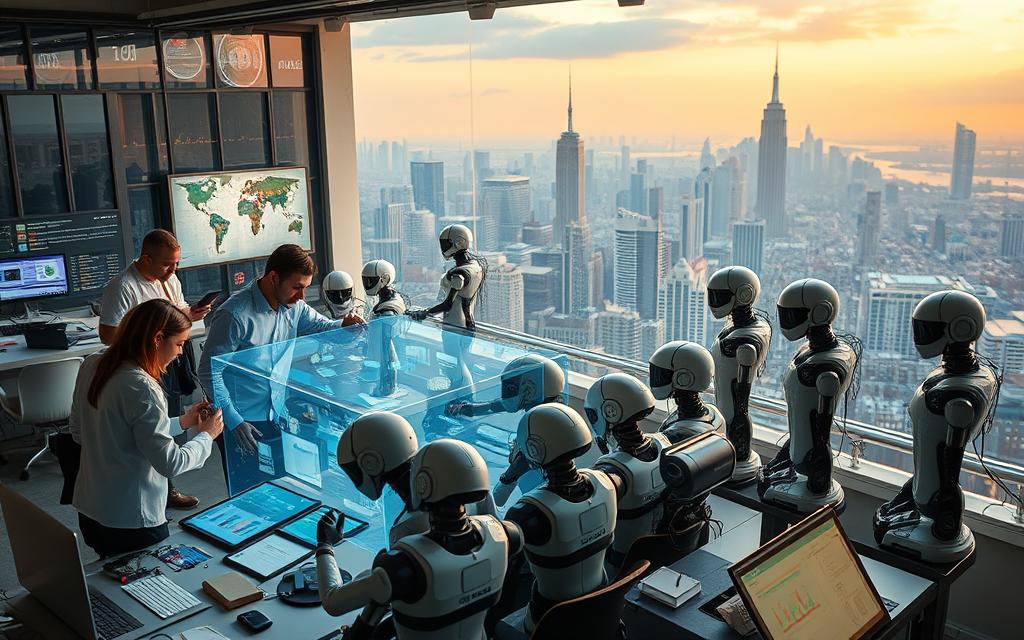
Accenture’s Fusion Teams model shows how cognitive partnerships can increase productivity by 43%. These teams mix data scientists with frontline workers to improve AI results. Siemens’ MindSphere teams, for example, cut down on IoT errors by 29% through feedback.
Workflow Integration Consultants
These specialists have three main goals:
- Mapping existing business processes for AI augmentation
- Designing training for workers to adapt to AI
- Setting up metrics for how humans and AI work together
As a Siemens engineer puts it: “Our role isn’t to replace workers – it’s to redesign how humans and machines co-create value.”
Ethical Considerations for Workforce Transition
Automation is changing industries fast. Policymakers must balance tech progress with worker safety. They need to keep social safety nets strong while helping workers who lose their jobs. This is a big challenge that needs everyone to work together.
Universal Basic Income Debates
Finland tried out Universal Basic Income (UBI) from 2017 to 2018. They gave €560 a month to 2,000 jobless people. The results showed less stress but no change in jobs. This has sparked many debates.
- Long-term economic sustainability
- Incentive structures for workforce participation
- Alternative models like wage insurance schemes
The World Economic Forum suggests a mix of short-term income help and training. This idea fits well with ethical AI use.
Retraining Programme Responsibilities
Germany kept 75% of salaries during COVID-19 with a special scheme. AT&T also spent $1 billion on training its workers. These examples make us think about who should help workers most.
Corporate vs Government Obligations
Deloitte looked at 142 partnerships between companies and governments. They found three good ways to work together:
- Regional skills councils (UK model)
- Tax credit incentives (Singaporean approach)
- Industry-specific training levies (South African example)
Salesforce has helped 850,000 workers with free courses. But Bridgewater says we need to do 300% more to keep up with tech.
We need to rethink how we work together. We must make sure new tech doesn’t hurt people.
Adaptation Strategies for Businesses
Artificial intelligence is changing how industries work. Companies are using two main strategies to stay ahead. They focus on workforce upskilling initiatives and job redesign frameworks. This way, they make the most of both human skills and AI.

Workforce Upskilling Initiatives
Top companies are creating continuous learning cultures. They offer special training programmes. For example, Amazon’s Machine Learning University has trained over 20,000 employees in AI engineering. Within 18 months, 68% of these employees got promoted.
JPMorgan Chase also sees great results. AI-trained staff are 40% more productive in certain tasks. This shows how important upskilling is.
Unilever is combining digital badges with mentorship. This approach keeps 92% of reskilled employees. It helps workers learn to use AI for routine tasks, freeing them to make important decisions.
Amazon’s Machine Learning University Model
Amazon’s six-month certification includes:
- Practical ML implementation workshops
- Real-world supply chain optimisation projects
- Cross-departmental innovation challenges
Job Redesign Frameworks
IBM is using human-centred design to change jobs. Its augmented intelligence helps HR teams handle more queries. This way, they can focus on the complex cases that need human touch.
IBM’s Augmented Intelligence Approach
Siemens and EdgeCase Technologies are working together in manufacturing:
| Role Component | Human Responsibility | AI Contribution |
|---|---|---|
| Quality Control | Final defect assessment | Automated visual inspection |
| Process Optimisation | Strategic improvements | Real-time data analysis |
Pfizer has cut drug development time by 14 months with AI. This shows how cognitive offloading lets humans focus on new ideas. It’s clear that redesigning jobs can lead to real benefits.
Individual Preparation Tactics
To succeed in the AI job market, professionals must keep learning and develop versatile skills. Those who adapt quickly and plan their careers well will find more opportunities.

Lifelong Learning Methodologies
Today, workers focus on stackable credentials more than traditional degrees. Google Career Certificates show 40% of graduates don’t have a bachelor’s degree. This proves these programs open doors for different types of talent.
Micro-credentialling Systems
MIT’s MicroMasters in Supply Chain Analytics shows how small qualifications can lead to AI jobs. LinkedIn found that those with three+ micro-credentials get 28% more job offers than others.
| Platform | Key Offerings | Industry Impact |
|---|---|---|
| Coursera | AI Skill Specialisations | 62% career progression rate |
| Udacity | Nanodegrees | 89% completion relevance |
| EdX | Professional Certificates | 3x hiring likelihood |
Career Portfolio Development
L’Oréal’s talent marketplace shows the value of T-shaped skills. These are deep knowledge in one area plus skills in other areas. Employees moving through AI teams got 34% more promotions.
“Future-ready professionals need skills maps that balance technical depth with adaptive breadth.”
Cross-industry Skill Transferability
Marketing experts learning Python for AI analytics show career agility. Coursera’s SkillsGraph shows 73% of in-demand skills are used across many sectors, from healthcare AI to retail automation.
Workers should check their skills every quarter using BCG’s four-pillar model. This ensures their skills stay relevant as industries change with AI.
Conclusion
We need a workforce that works together with AI. Northwestern University says design thinking is key to solving big problems. This approach matches Microsoft President Brad Smith’s call for humans to lead in using technology.
Being adaptable is key in today’s AI world. Northwestern University and Ray Dalio’s work show how important it is. In Singapore, 650,000 people each year get help to improve their skills, thanks to the government.
Businesses that work well with AI see a 23% boost in productivity, MIT found. They use Eric Horvitz’s design to make the most of both humans and machines. This way, humans can focus on big decisions while machines do the detailed work.
The next ten years will ask us to change how we see ourselves at work. We should see AI as a tool to help us, not replace us. This way, we can solve problems better and keep our creativity alive.