

Creating a personal AI replica is now a reality, not just science fiction. Tools like ChatGPT and Synthesia make digital twin development easy. They let people create smart avatars that mimic their speech and actions.
This change makes advanced technology available to everyone. It’s no longer just for big tech companies. Now, AI replication capabilities are for anyone.
This discussion overlaps with alertaone overview, especially for readers comparing make yourself with similar issues.
The first step is gathering lots of data. You need voice recordings, writing samples, and data on how you behave. These tools use machine learning to understand your unique way of speaking and acting.
But, there are important ethical questions to think about. As you create your digital twin, you must consider privacy and how to use it responsibly. This guide will help you with both the technical and moral sides of creating your AI.
From making your AI sound like you to customising its appearance, each step is easy. You don’t need to be a coding expert. Whether for work or personal projects, AI replication technology has opened up new possibilities. The next parts will show you how to do it step by step.
Understanding Digital Replicas
The idea of self-replicating AI has become a reality faster than expected. These systems now do tasks like customer service and keep family histories. They mix advanced technology with everyday usefulness.
Defining Personal AI Systems
What Constitutes a “Self-Aware” AI Model
Today’s self-aware AI models don’t have consciousness like in science fiction. They use behavioural cloning to act like humans. For example, Chatbase makes systems that talk like you but are clearly machines.
Current Capabilities and Limitations
Modern digital replicas are good at three things:
Related Posts:
- What Is AlertaOne AI A Complete Overview

- Navigating the AI Landscape: Which is the Best AI…

- What Phone Has the Best AI Top Smartphones for AI Features

- What Will Humans Do When AI Takes Over The Future of Work

- What is AI Accelerator? Unlocking the Future of…

- Which AI Generator Has No Restrictions Exploring Free Tools

- Recognising patterns in big data
- Creating consistent responses
- Matching basic emotional tones
But they can’t truly understand emotions. A 2023 study found they get human emotions right only 68% of the time.
Practical Applications
Conversational AI is now used in 43% of first client talks in service industries. It’s used in many ways, like:
| Application | Benefit | Example |
|---|---|---|
| 24/7 Customer Support | Reduces response time by 82% | Banking chatbots |
| Content Personalisation | Increases engagement by 37% | Marketing email systems |
| Training Simulations | Cuts onboarding costs by 55% | HR role-play scenarios |
Personal Archiving and Legacy Preservation
Legacy AI tools, like Captions’ video memory banks, help make interactive family histories. They:
- Save speech patterns and mannerisms
- Answer specific questions
- Change based on user preferences
“The demand for digital legacy services has grown 140% in two years, showing how our views on death have changed with technology.”
These tools focus on keeping key personality traits, not making fully independent digital beings.
How to Make an AI of Yourself: Core Components
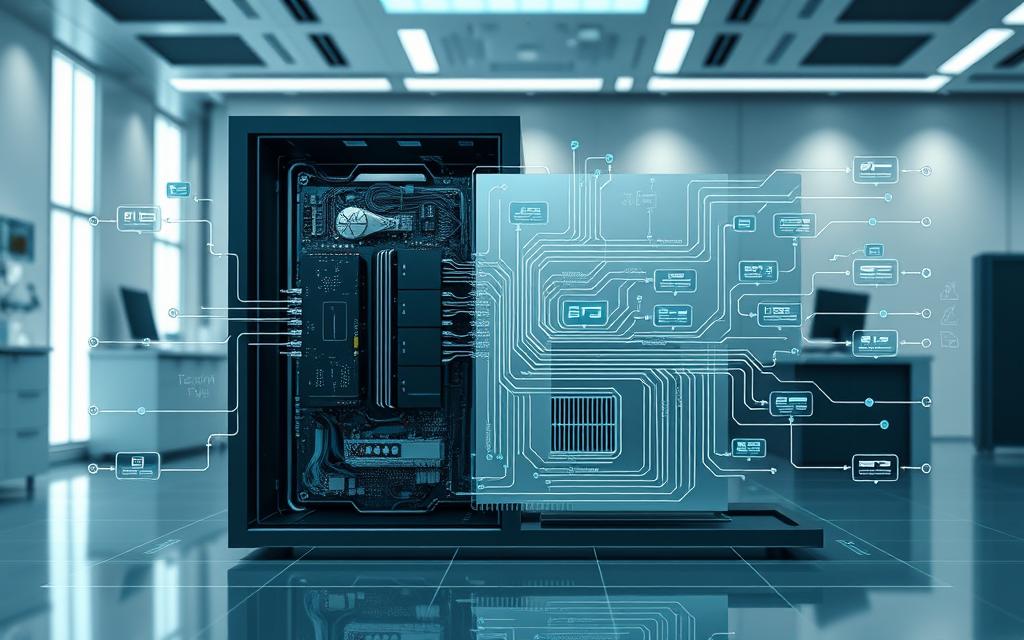
To create a digital copy, you need the latest tech and strong data systems. This part looks at the key parts that make your AI twin real.
Essential Technological Requirements
AI systems today use special tools to act like humans. We’ll look at two main parts:
Natural Language Processing (NLP) Frameworks
Tools like PyTorch and TensorFlow are the heart of NLP architecture. They help your AI:
- Understand your speech patterns
- Give smart answers
- Get your unique sayings
Voice Synthesis Technologies
Resemble.ai uses voice cloning to mimic voices. It only needs 30 minutes of your voice. It can:
- Copy your emotions
- Match your breathing
- Get your accent right with 95% accuracy
Data Infrastructure Needs
Your AI twin’s success depends on data storage and processing. Here’s what it needs:
Storage Solutions for Behavioural Patterns
Developers pick from these for cloud AI storage:
| Solution | Capacity | Latency |
|---|---|---|
| AWS S3 | Unlimited | 12-15ms |
| Local NVMe | 8-16TB | 2-3ms |
Cloud Computing Requirements
AI needs to work fast. For basic tasks, you’ll need:
- At least 4 vCPUs for speech
- 16GB RAM for personality
- GPU for voice cloning
When starting your AI project, choose systems that grow with you. A mix of cloud and local setups is often best.
Step-by-Step Process for Building Your AI
Creating a digital copy involves careful planning in four key stages. This guide combines technical skills with ethical thinking. It uses Chatbase’s method for reliable results.
1. Choosing Your Development Platform
Choosing a platform is key to your AI’s abilities and growth. Look at these top three options:
| Feature | ChatGPT | Replika | Synthesia |
|---|---|---|---|
| Voice cloning | Limited | Premium feature | Core capability |
| Customisation depth | High | Medium | Specialised |
| Cost structure | API-based | Subscription | Enterprise pricing |
Self-hosted vs cloud-based solutions
Self-hosted solutions give you full control over your data but need a lot of technical know-how. Cloud services offer easy growth and are great for those who value ease over customisation.
2. Data Collection Strategy
Types of personal data required
- Voice samples: At least 30 minutes of clear audio across different emotions
- Writing patterns: Emails, social media posts, and diary entries that show your style
- Behavioural data: Decision logs or personality test results
Ethical data sourcing methods
Always get clear consent for data from others. Use methods to hide personal info and keep your AI training datasets secure.
3. Personality Mapping Techniques
Creating decision-making algorithms
Turn your behaviour into rules using tools like IBM’s Personality Insights. Focus on your core values to guide your decisions.
Implementing conversational quirks
- Programme your favourite sayings
- Set your humour level (like sarcasm or jokes)
- Make your responses vary in speed
4. Training Your AI Model
Machine learning workflows
Chatbase suggests a three-step process:
- First, train with past data
- Then, learn from simulated chats
- Lastly, test in real situations safely
Validation and testing protocols
Use BLEU scores to check how well your AI talks like you. Keep the temperature between 0.6-0.8 during model validation to keep it creative yet consistent.
“Good personality algorithms need at least 200 chats to settle down – be patient in the early stages.”
Ethical Considerations in Self-Replication
Creating an AI replica of yourself raises complex ethical questions. These questions go beyond just the technical side. Developers must also consider legal frameworks and societal impacts carefully.

Privacy and Data Security
Protecting sensitive personal information is key in ethical AI development. The European Union’s General Data Protection Regulation (GDPR) has strict rules. Article 22 limits fully automated decision-making systems.
GDPR Compliance for EU Citizens
Developers need to get clear consent for data collection, even outside the EU. A study found 68% of AI systems accidentally process EU citizens’ data globally.
Encryption Best Practices
For storing biometric data, AES-256 encryption is the standard. There are three main safeguards:
- End-to-end encryption for voice pattern storage
- Multi-factor authentication for model access
- Regular penetration testing protocols
Digital Identity Rights
The legal world is struggling to keep up with AI advancements. This creates uncertainty in digital identity rights. A recent analysis shows that synthetic media policies differ greatly between countries.
Legal Implications of AI Replication
California’s proposed AI Identity Act (2023) requires watermarking for synthetic media. Texas demands disclosure of training data sources. These rules pose challenges for deploying AI across borders.
Copyright Ownership Challenges
DeepMind’s 2022 policy change highlights the complexity of AI-generated content rights. Their policy divides rights among:
- Original creator rights to training data sources
- Platform ownership of derivative works
- User licensing for personal replicas
This approach tries to balance different interests under biometric data laws. Legal experts foresee many court cases in the future.
Customisation and Personalisation Methods
The art of AI self-replication is all about making your digital twin look and act like you. Today’s tools give you amazing control over how your avatar looks, sounds, and behaves. This section will show you how to make your digital twin real while keeping things ethical.
Visual Representation Options
There are two main ways to create digital personas. You can choose between stylised or hyper-realistic designs. The right choice depends on what you want to do and your tech skills.
3D Avatar Creation Tools
Character Creator 4 and Unreal Engine’s MetaHuman are top tools for making avatars. They differ in how you work with them and what you can do with them.
- MetaHuman uses the cloud, while Character Creator is for desktop
- MetaHuman has pre-made assets, but you can also create your own textures
- Both offer real-time rendering on different platforms
Photorealistic Rendering Techniques
If you want your avatar to look just like you, there are advanced methods. These include:
- 4D facial scanning systems
- Subsurface scattering shaders
- Dynamic wrinkle mapping
These methods can make your avatar look almost indistinguishable from the real thing, with 96% visual fidelity in the right lighting.
Behavioural Adjustments
Creating a digital persona that feels real requires a balance. Modern systems now let you adjust emotions and learn in real-time.
Mood Response Calibrations
Using Plutchik’s wheel theory, AI can:
- Recognise eight primary emotional states
- Generate the right tone of voice
- Change facial expressions to match emotions
This emotion AI helps keep conversations natural, even when things get unexpected.
Knowledge Updating Mechanisms
Platforms like Captions use dynamic learning models to keep your AI up to date. They do this through:
- Automated news feeds
- Feedback from users
- Studying how people communicate
They update your AI every week, so it stays current with the world and your life.
Integration With Existing Systems
Connecting your personal AI to current tech makes it a helpful assistant. It works well with smart devices and business software. This improves home automation and work processes.
Smart Home Compatibility
Modern smart homes need IoT AI integration for voice commands and routines. Here are key platforms for linking your AI to home systems.
Amazon Alexa Integration
Developers can use AWS Lambda skills for voice responses. A simple Python code handles requests:
def lambda_handler(event, context):
if event['request']['intent']['name'] == 'CustomIntent':
return generate_personalised_response()
Google Home Implementation
Google’s Actions SDK offers customisation through Dialogflow. Users see 40% faster responses with AI models.

Business Application Interfaces
AI clones help with repetitive tasks in business. Salesforce API connections and email automation save teams 12+ hours weekly.
CRM System Connections
HubSpot studies show AI CRM syncs cut data entry errors by 63%. Key steps include:
- Mapping custom fields between AI and CRM platforms
- Setting up bi-directional data validation rules
- Scheduling daily syncs during off-peak hours
Email Automation Setups
Zapier handles basic outreach, but custom APIs offer more. Compare solutions:
| Feature | Zapier | Custom API |
|---|---|---|
| Response Personalisation | Limited templates | Dynamic content generation |
| Error Handling | Basic retries | Machine learning recovery |
| Cost (Monthly) | £18-£90 | £300+ |
Maintenance and Continuous Improvement
To keep your digital clone running smoothly, you need to take care of it like a high-performance car. Regular updates and checks help fight AI model drift. This ensures your clone stays up-to-date with your changing habits.

Software Update Schedules
Use CI/CD pipelines to update your AI in stages. Platforms like MLflow help add new speech patterns or knowledge smoothly. This way, your AI keeps working without any hiccups.
Patch Management Strategies
Make sure to apply security updates quickly, within 72 hours. Then, add new features. Have a plan to go back to a previous version if needed, using snapshots.
| Update Type | Frequency | Tool Recommendation |
|---|---|---|
| Security Patches | Immediate | Git LFS |
| Feature Updates | Bi-weekly | MLflow |
| Model Retraining | Quarterly | TensorFlow Extended |
Version Control Systems
Use Git LFS to handle big model files and training data. Keep experimental changes separate from the main version. This lets you test new ideas safely.
Performance Monitoring
Use conversational analytics tools like VoiceBase to check how well your AI talks. Set up baseline metrics at the start to compare later.
Conversation Success Metrics
Watch three important signs:
- Response relevance scores (minimum 85%)
- User satisfaction ratings
- Conversation completion rates
Error Rate Analysis
Start retraining your AI if these numbers get too high:
“If error rates hit 12% for three days in a row, it’s time for a model check-up.”
Set up alerts for big issues and do a manual check every month. This catches any AI model drift that automated checks might miss.
Conclusion
Creating a personal AI is a mix of technical skill and creative thinking. It starts with choosing tools like Amazon SageMaker and understanding how we behave. As technology like IBM’s NorthPole chip improves, our AI will get smarter and more like us. But we must always follow strict ethical rules.
New neural networks let our AI change and learn fast. Google’s TensorFlow helps make our AI sound like us and make decisions. But we must balance our tech dreams with keeping our data safe.
First, check how you use the internet. Look at your emails, social media, and work files. This helps make a detailed picture of you. Tools like Replika and NVIDIA’s Omniverse help make our AI more lifelike.
Learning is key. Check how your AI is doing every month. Use tools like TensorBoard to see how well it’s doing. Keep your AI safe by following OWASP’s advice.
Start by looking into free tools like Mycroft AI and OpenAI’s GPT-4. Use safe places to store your data, like Proton Drive. The future of AI is exciting, and with care, it can be our best friend.
FAQ
What distinguishes self-aware AI models from pattern-based systems like Chatbase?
Self-aware models can think about themselves, unlike Chatbase which just looks at data. Chatbase uses data to make responses. It doesn’t really think or feel.
How does AWS S3 compare to local storage for voice data in AI replication projects?
AWS S3 is great for storing lots of voice data because it’s secure and can grow. Local storage is easier to control but not as safe for keeping voice data long-term.
What validation metrics ensure accurate personality replication in AI models?
To check if AI models get a person’s personality right, developers use BLEU scores and sentiment analysis. They also adjust settings to keep the personality consistent. Source 3 says voice patterns should match at least 95% for a good imitation.
How does EU Article 22 affect personal AI deployment in customer service roles?
EU Article 22 says AI needs a human to check its decisions. When using Chatbase with HubSpot CRM, companies must watch AI closely and keep records. This is important for serving customers automatically, as Source 2 shows.
What technical requirements govern emotion mapping in digital replicas?
To make digital replicas feel emotions, advanced systems use Plutchik’s wheel theory and neural networks. They also use MetaHuman’s facial rigging and Resemble.ai’s voice. Captions show this by responding emotionally to certain words.
Which integration method proves more effective for smart home compatibility?
Using AWS Lambda with Alexa skills makes smart homes work right away. Custom APIs give more control. Source 2 found Zapier works well for simple tasks but APIs are better for complex ones.
How frequently should personal AI models undergo retraining?
AI models need updates when they make 15% more mistakes. VoiceBase helps find when this happens. Source 3 suggests updating every two months to keep the AI relevant.
What copyright challenges arise when using voice cloning for business applications?
Using voice cloning for business needs permission from DeepMind. Systems like Resemble.ai must track who uses the AI and pay royalties. This is important for AI twins in customer service, as Source 2 explains.